
The Supreme Court ruled Christian symbols cannot be displayed. Jewish symbols can. This tells you everything about who rules America.
In 1989, the Supreme Court of the United States issued one of the most revealing rulings in American legal history. In Allegheny County v. ACLU, the Court held that a Christian nativity scene displayed on government property violated the Establishment Clause. It was an unconstitutional endorsement of religion. But in that very same ruling, the Court held that a Jewish menorah displayed by the government was perfectly constitutional.
Read that again. Let it sink in.
A nativity scene depicting the birth of Jesus Christ—the central event of the faith that built Western civilization, that founded this nation, that animated its laws and customs and holidays for centuries—is forbidden. But a menorah celebrating Hanukkah—a minor Jewish festival commemorating a military victory that has nothing to do with American history or heritage—is permitted.
This was the legal establishment of Jewish religious supremacy over Christianity in the public square.
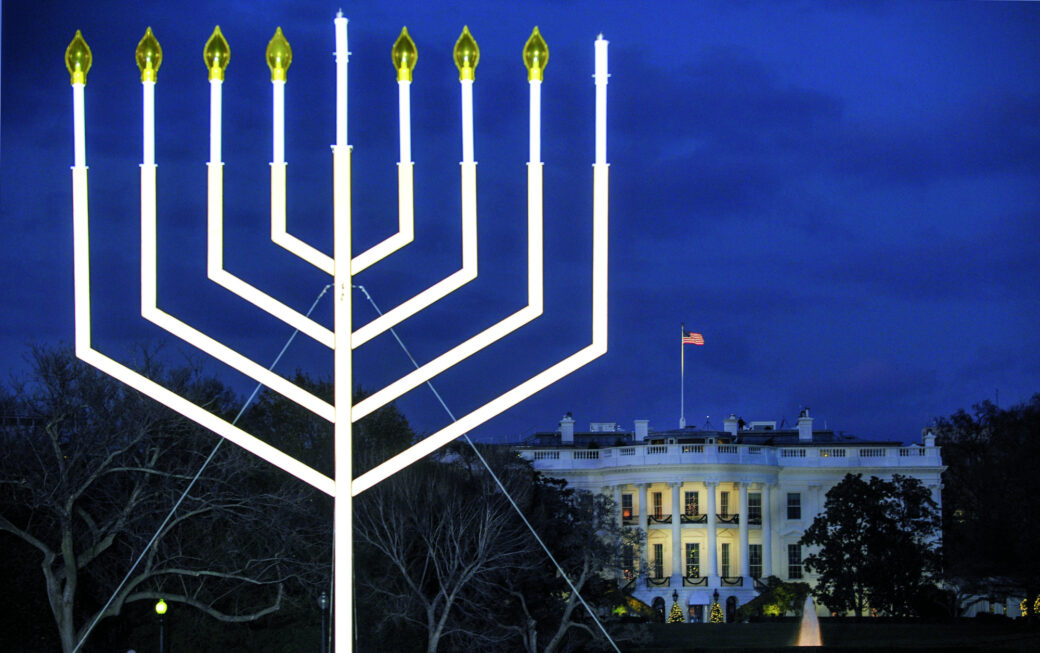
Walk past the White House during the Christmas season and witness the fruit of this ruling. You will see a menorah. You will not see a nativity scene.
The residence of the American president—the leader of a nation founded by Christians, built by Christians, populated overwhelmingly by Christians—displays the religious symbol of a tiny 2% minority of our nation’s people while the symbol of the faith of the majority is legally forbidden. This is not an accident, it is a statement of power. A humiliation ritual of a conquering tribe over a conquered nation.
Every year, the President of the United States hosts a Hanukkah celebration at the White House. Jewish leaders gather in the people’s house to celebrate a Jewish holiday with Jewish prayers and Jewish ceremonies. The President lights the menorah and praises America’s commitment to the Jewish people and the Jewish state.
At last night’s Hanukkah event, the Jewish commentator Mark Levin declared: “Six years ago I said Trump is our first Jewish president.” Trump’s response? “It’s true.” This is the same Mark Levin who, when confronted by a young White man suggesting that Mark’s poor behavior fuels antisemitism, replied with: “It’s in your family’s DNA.”
Consider what this means. The President of the United States publicly affirms that he governs as a Jewish president. This is said openly, proudly, at an official White House religious ceremony. And no one blinks. No one objects. No one points out the staggering implications of the leader of a Christian nation declaring himself to be, in effect, a servant of Jewish interests.
Imagine if a President attended a Christmas celebration and said, “I am America’s first truly Christian president. My administration serves Christ and His Church above all.” The howling would be deafening. The lawsuits would be immediate. The media would declare a constitutional crisis. But a President declaring himself a Jewish president at a Jewish religious ceremony in the White House? This is normal. This is expected. This is simply how power operates in occupied America.
There is a deeper theological irony that most Christians never consider. Hanukkah commemorates the rededication of the Second Temple—the very temple that God Himself would utterly demolish within the generation of Christ’s resurrection.
Jesus prophesied this destruction explicitly. “Do you see all these great buildings?” He asked His disciples as they admired the temple. “Not one stone here will be left on another; every one will be thrown down” (Mark 13:2). In 70 AD, this prophecy was fulfilled with terrible precision. The Roman legions under Titus razed the temple so completely that its very foundations were torn apart. God did not preserve His house. He demolished it, permanently. There has been no temple for nearly two thousand years, and there never will be again, because the temple’s purpose was fulfilled in Christ. He is the temple now. His body, broken and risen, replaced the building of stone.
Hanukkah celebrates the rededication of a structure that God rejected and destroyed. To celebrate Hanukkah is to celebrate a building that Christ rendered obsolete. It is to honor a sacrificial system that His sacrifice ended. It is to cling to shadows when the substance has come.
But there is something darker still. The Gospel of John records that Jesus was in Jerusalem during the Feast of Dedication—Hanukkah—when the Jews surrounded Him in the temple courts and demanded He tell them plainly if He was the Christ. When He answered, declaring “I and the Father are one,” they picked up stones to kill Him (John 10:22-31). Hanukkah, in the scriptural record, is the feast during which the Jews attempted to murder the Son of God for declaring His divinity.
This is what Christians celebrate when they light the menorah and wish their Jewish neighbors a happy Hanukkah. They celebrate the feast of Christ’s rejection. They celebrate the day stones were gathered to kill Him. They celebrate a temple that God Himself destroyed as judgment for that rejection.
Any Christian who participates in Hanukkah willingly mocks the Gospel. They side with those who rejected Christ against Christ Himself. They honor a religious system that God abolished in fire and blood. They treat the murderous rejection of the Messiah as a festive occasion worthy of celebration.
This is not interfaith goodwill. This is apostasy with a smile.
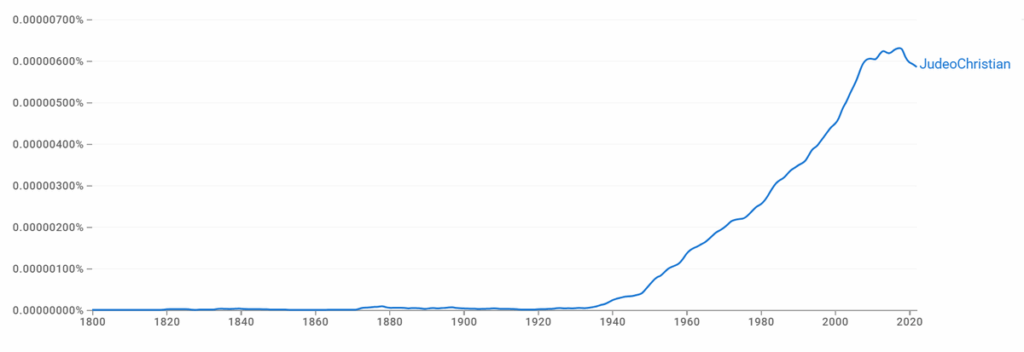
To maintain the illusion that Christians and Jews share common cause, a linguistic fiction was invented: the “Judeo-Christian tradition.” This phrase, which was nonexistent prior to the 1930’s, is now ubiquitous in conservative discourse. It is invoked endlessly by politicians, pundits, and pastors who wish to appear both pious and politically safe. It is, in reality, an anti-Christian fabrication. A contradiction in terms designed to obscure fundamental theological realities for political purposes.
There is no Judeo-Christian tradition. There is Christianity, which teaches that Jesus Christ is the Son of God, the promised Messiah, the fulfillment of all Old Testament prophecy, and the only path to salvation. And there is Judaism, which explicitly rejects all of this. Jews hold that Jesus was a false messiah, a blasphemer, and a deceiver. These are mutually exclusive truth claims. One of them is right and the other is wrong. They cannot both be true, and pretending they represent a shared “tradition” is either ignorance or deception.
The term “Judeo-Christian” was virtually unknown before the twentieth century. It was popularized in mid-century America as part of a deliberate campaign to reshape American identity and to downplay the specifically Christian character of the nation and to elevate Judaism to equal status despite Jews comprising a tiny fraction of the population. The goal was not theological accuracy but political utility: to bind Christians to Jewish interests, to make support for Israel a religious obligation, and to silence any Christian who might notice that Jewish political activism frequently undermines Christian values and Christian communities.
The effect of “Judeo-Christian” language is to Judaize the faith. It implies that Christianity is incomplete without Judaism, that the Church needs the Synagogue, that Christ’s finished work on the cross must be supplemented by ongoing deference to those who reject Him. This is theological nonsense and dangerous nonsense at that. Christ declared “It is finished.” The veil of the temple was torn. The old covenant was fulfilled and superseded. Christianity is not a branch of Judaism; it is the fulfillment of everything the Old Testament promised and the replacement of everything the old covenant instituted.
Who benefits from this arrangement? Who benefits when Christians are taught that their faith requires them to support a foreign ethnostate? Who benefits when American treasure flows by the billions to a nation on the other side of the world? Who benefits when American soldiers die in wars that serve Israeli interests? Who benefits when any criticism of these policies is instantly denounced as bigotry and hatred?
Not the American people. Not American Christians. Not the young men who come home in coffins from Middle Eastern wars. Not the taxpayers who fund Iron Dome while their own cities crumble. Not the families who watch their wealth eroded by inflation while foreign aid flows uninterrupted.
The “Judeo-Christian” deception is a mechanism of exploitation. It takes the sincere faith of American Christians and their desire to be faithful to Scripture and to stand on the right side of biblical prophecy and weaponizes it to advance interests that are not their own. It transforms Christian piety into a blank check for a foreign nation and a domestic lobby.
And it works. It works because good-hearted Christians have been taught that questioning this arrangement is sin. It works because pastors repeat the propaganda from their pulpits. It works because politicians know that waving the Israeli flag guarantees evangelical support. It works because the machinery of influence operates so smoothly that most Americans never stop to ask why their supposedly secular government hosts religious ceremonies for one faith while banning the symbols of another.
We are an occupied nation. This is not hyperbole. This is a precise description of our political reality.
An occupation does not require foreign troops on the streets. It requires foreign interests controlling the levers of power. It requires the occupied population funding and fighting for the occupier’s benefit. It requires the suppression of any resistance, any dissent, any recognition of what is happening.
By these measures, America is occupied territory. Our foreign policy is made in Tel Aviv. Our domestic discourse is policed by organizations that explicitly serve Jewish interests. Our laws permit Jewish religious displays while banning Christian ones. Our presidents declare themselves servants of a foreign nation. And anyone who states these plain facts is destroyed—professionally, socially, financially.
The menorah on the White House lawn is a symbol of conquest. It says: we rule here. It says: your symbols are forbidden, ours are celebrated. It says: your faith is subordinate to ours. It says: this is our house now.
The first step toward liberation is recognition. You cannot free yourself from a bondage you refuse to see. You cannot resist an occupation you insist does not exist. The “Judeo-Christian” spell must be broken. The legal double standard must be named. The political reality must be acknowledged.
Christianity does not need Judaism. The Church is not incomplete without the Synagogue. Support for Israel is not a biblical mandate, it is a political position, and one that can be questioned, criticized, and rejected like any other political position. The interests of the Jewish state are not identical to the interests of the American nation, and pretending otherwise is not faithfulness but foolishness.
Christ is King not one king among many, not a junior partner in a Judeo-Christian alliance, but the King of Kings and Lord of Lords before whom every knee shall bow. His Church is not a subset of Judaism but its fulfillment. His people are not defined by ethnicity but by faith. And His Kingdom will not be inherited by those who reject Him, no matter how much political power they accumulate in the meantime.
The menorah stands on the White House lawn. The nativity is banned. One president after another declares loyalty to a foreign nation. And Christians are told this is their tradition, their obligation, their faith.
It is time to reject the lie. It is time to reclaim what was stolen. It is time to remember whose nation this is—and whose it is not.
Christ is King. America is a Christian nation. And no amount of legal sophistry or political theater can change that truth.
Andrew Torba
CEO, Gab.com
Christ is King