

The Founders did not create a “proposition nation.” They created a homeland for their posterity. The historical record is unambiguous.
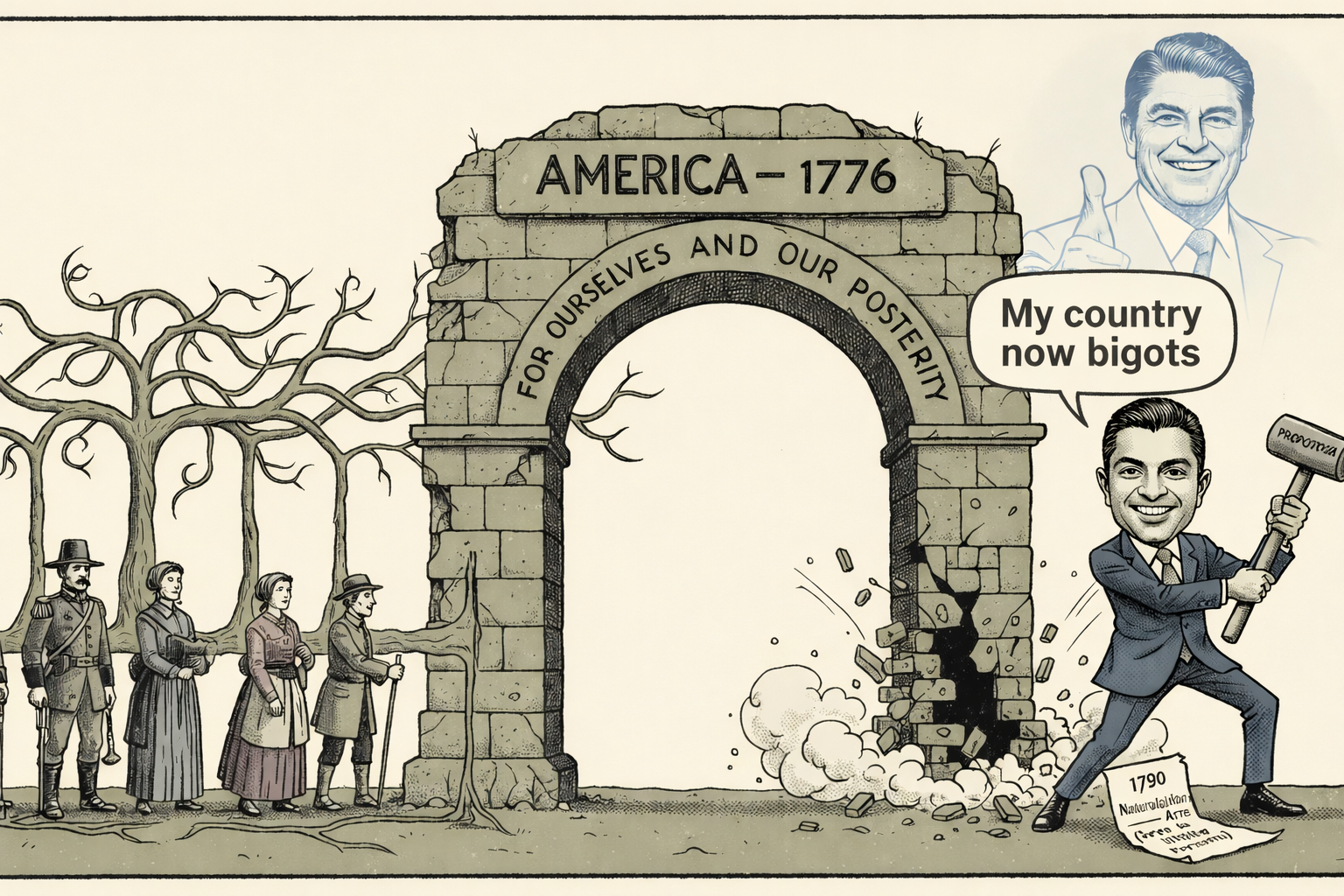
Vivek Ramaswamy has taken to the pages of the New York Times to lecture heritage Americans about what their country really means. According to this son of Indian immigrants—born in 1985 to parents who arrived after the 1965 Immigration Act abolished the national origins system—America is not a nation in any traditional sense. It is an idea. A creed. A set of propositions to which anyone on earth can subscribe and thereby become “every bit as American as a Mayflower descendant.”
This is not history. This is mythology. And it is mythology that serves the interests of those who benefit from the displacement of the historic American nation while providing ideological cover for that displacement.
Let us examine what the Founders actually believed, what they actually wrote, and what they actually established—as opposed to what Vivek Ramaswamy wishes they had believed.
The Preamble to the Constitution states the purpose of the document with crystalline clarity: “to secure the Blessings of Liberty to ourselves and our Posterity.” Not to mankind. Not to anyone who subscribes to certain ideals. To ourselves and our posterity—the descendants of those who founded the nation.
Who were those founders? They were, without exception, White Europeans. They did not imagine that they were creating a framework for the world to inhabit. They were creating a homeland for their children and their children’s children.
The Naturalization Act of 1790—the very first law passed by Congress on the subject of citizenship—restricted naturalization to “free White persons of good character.” This was not an oversight. This was not a temporary compromise with bigotry that would later be corrected. This was the deliberate and considered judgment of the Founding generation about who could become an American.
This racial requirement for citizenship remained the law of the land for the first eighty years of the Republic. It was reaffirmed repeatedly. It was understood by everyone to reflect the Founders’ vision of America as a nation for Europeans. The supposed “proposition nation” that Vivek celebrates did not permit his ancestors to become citizens. They were explicitly excluded—by design.
What did the Founders think about the proposition that “anyone from any corner of the world” could become American? They told us directly.
Benjamin Franklin worried about German immigration to Pennsylvania, asking: “Why should Pennsylvania, founded by the English, become a Colony of Aliens, who will shortly be so numerous as to Germanize us instead of our Anglifying them?” If Franklin was concerned about Germans—fellow Europeans, fellow Protestants—what would he have thought about mass immigration from India?
Thomas Jefferson, in Notes on the State of Virginia, warned against immigration from nations with different political traditions: “They will bring with them the principles of the governments they leave… These principles, with their language, they will transmit to their children.” Jefferson understood that people carry their culture with them, that nations are not merely ideas but peoples with distinct characters.
John Jay, in Federalist No. 2, celebrated the homogeneity of the American people: “Providence has been pleased to give this one connected country to one united people—a people descended from the same ancestors, speaking the same language, professing the same religion, attached to the same principles of government, very similar in their manners and customs.”
One people. Same ancestors. Same language. Same religion. Same manners and customs. This is not a description of a “proposition nation” open to anyone who mouths the right words about the Constitution. This is a description of a nation in the traditional sense—a people bound by blood, culture, and history.
Vivek approvingly quotes Ronald Reagan: “You can go to live in France, but you can’t become a Frenchman; but anyone from any corner of the world can come to live in the United States and become an American.”
This is perhaps the most destructive lie ever told about American identity. It has been repeated so often that even conservatives accept it as self-evident truth. It is, in fact, a complete fabrication—a revision of American history that would have been unrecognizable to every generation of Americans before the mid-twentieth century.
For most of American history, you could not become an American if you were not White. The law said so explicitly. The Founders said so explicitly. The nation was understood—by Americans and by the world—as a White European nation. Chinese were excluded entirely after 1882. Japanese were barred from citizenship. Indians—Vivek’s ancestors—were ruled ineligible for naturalization by the Supreme Court in 1923 because they were not White.
The idea that America was always a “proposition nation” open to the world is a post-World War II invention. It was manufactured by Jewish intellectuals hostile to the historic American nation and popularized by politicians eager to justify the 1965 Immigration Act that opened the floodgates to the third world. Reagan was not articulating timeless American principles. He was repeating propaganda that had been crafted within living memory.
Vivek’s vision is not merely historically illiterate. It is also incompatible with the Biblical understanding of nationhood.
The Scriptures speak of nations as extended families—peoples bound by common descent, not common ideology. The very word “nation” derives from the Latin natio, meaning “birth” or “race.” In the Greek of the New Testament, the word is ethnos—from which we derive “ethnic.” Nations are, by definition, ethnic communities. They are not philosophical clubs.
God created the nations at Babel, separating humanity into distinct peoples with distinct languages and distinct territories (Genesis 11). He “made from one man every nation of mankind to live on all the face of the earth, having determined allotted periods and the boundaries of their dwelling place” (Acts 17:26). He established nations with boundaries—not ideological constructs with open borders.
The Great Commission commands the Church to “make disciples of all nations” (Matthew 28:19)—to evangelize the distinct peoples of the earth, not to dissolve them into a single proposition-affirming mass. The vision of Revelation shows “a great multitude that no one could number, from every nation, from all tribes and peoples and languages” (Revelation 7:9)—distinct peoples, recognizable as such, standing before the throne. The nations persist into eternity.
God loves the nations as nations. He created their diversity. He assigned their boundaries. He commands His Church to disciple them as distinct peoples. The proposition nation—the idea that national identity is purely ideological and that ethnic heritage is irrelevant—is not a Christian concept. It is a liberal concept, a revolutionary concept, a concept that dissolves the natural bonds God created and replaces them with abstract ideology.
Vivek frames the current debate as “blood and soil” versus “ideals.” This is a false dichotomy designed to make the historic American position sound sinister.
The real divide is between those who believe America is a nation—a people with a history, a heritage, a culture, and a legitimate interest in its own continuity—and those who believe America is merely a platform for global human trafficking dressed up in constitutional language.
Vivek’s position is that an Indian born to Indian parents, raised in Indian culture, holding Indian religious beliefs, is “every bit as American as a Mayflower descendant” as long as he affirms certain propositions. This is absurd on its face. It is an insult to the families who built this nation over four centuries. It is a denial of everything that makes nationhood meaningful.
Can an Indian become a citizen of the United States? Under current law, yes. But citizenship is a legal status, not an identity. A passport does not make you a member of a people. Signing documents does not give you ancestors. The ideological reductionism that Vivek promotes erases the distinction between legal citizenship and genuine nationality—and it does so deliberately, because that erasure serves the interests of recent arrivals who wish to claim equal ownership of a nation they did not build.
Vivek accuses the “Groyper right” of identity politics while practicing identity politics himself. His entire article is an exercise in ethnic advocacy. He is an Indian defending Indian immigration, attacking those who question whether mass third-world immigration is good for America, and demanding that White Americans abandon any sense of ethnic solidarity while every other group maintains theirs. As I wrote last week, identity politics is politics and Whites are the only ethnic group in the world who are chastised for practicing it.
He complains about slurs directed at him online. But notice what he does not do: he does not grapple with the substantive arguments about immigration, demographics, and national identity. He simply points to mean words and declares the debate illegitimate. This is the same tactic the left has used for decades—crying bigotry to avoid engaging with arguments they cannot refute.
Politics, at its core, is about the distinction between friend and enemy. This is the fundamental insight that liberals—and conservatives who have internalized liberalism—refuse to accept. They imagine politics as a debate club where everyone shares the same basic goals and merely disagrees about methods. This is childish fantasy. Politics is about power: who has it, who wields it, and against whom.
Vivek Ramaswamy has revealed which side he is on, and it is not yours. When he wanted to attack heritage Americans who advocate for their own interests, where did he go? Not to a conservative publication. Not to a neutral platform. He went to the New York Times—the official newsletter of the anti-White ruling class, the flagship publication of everyone who wants you replaced and silenced. He ran to the enemy, used their megaphone, and recited their talking points.
This is not a policy disagreement among friends. Vivek holds the same fundamental view as the New York Times: that White Americans who organize in their own interests are uniquely dangerous and must be stopped. He shares their commitment to the liberal universalism that has systematically dispossessed heritage Americans. He shares their belief that America belongs to anyone who shows up and recites the right words. He shares their conviction that the Groyper right—young White men who have finally begun to fight back—represents the greatest threat to the order that benefits people like him.
When someone runs to your enemy’s publication to denounce you using your enemy’s language, he is not your friend who happens to disagree. He is your enemy wearing a Republican jersey. The friend-enemy distinction does not respect party registration. Vivek has made his choice. He has identified his tribe—and it is not heritage Americans. It is the cosmopolitan elite who see your displacement as progress and your resistance as pathology. Judge him by his actions: he wrote an op-ed for the New York Times attacking White advocates. That tells you everything you need to know about whose side he is on.
The young White Americans Vivek dismisses as “Groypers” are responding to observable reality. They have watched their country transformed without their consent. They have been told their entire lives that their race is uniquely evil, that their heritage is shameful, that their displacement is justice. They have been subjected to legal discrimination in university admissions and corporate hiring. They have been lectured about “White privilege” while watching their communities hollowed out by deindustrialization and their futures mortgaged by debt.
And now, when they finally begin to organize in their own interests—when they finally practice the same ethnic solidarity that every other group practices openly—they are condemned as un-American by a first-generation immigrant in the pages of the New York Times.
Vivek’s proposed solutions reveal the bankruptcy of his worldview. He wants to reduce housing costs, give everyone stock market shares, and inspire young people with a moon base. These are technocratic tweaks that entirely miss the point.
Young White Americans are not angry because housing is too expensive—although it is. They are angry because they have been dispossessed. They are angry because they have been demonized. They are angry because they are being replaced in their own country and told that noticing this makes them evil.
No amount of economic adjustment will address this anger, because it is not fundamentally economic. It is existential. It is the natural response of a people who have been told they have no right to exist as a people, no right to advocate for their interests, no right to a future in the nation their ancestors built.
Vivek offers more of the same liberalism that created this crisis. Colorblind meritocracy. Proposition nationalism. Economic incentives as a substitute for identity and belonging. This is not a solution; it is a continuation of the problem. It is an attempt to preserve the ideological framework that has systematically disadvantaged heritage Americans while pretending to offer them a fair shake.
Vivek Ramaswamy is not an authority on American identity. He is a beneficiary of policies that the Founders would have found unthinkable, defending an ideology that was invented to justify his presence here. His “proposition nation” is a fiction—a story told by those who displaced the historic American nation to legitimize their displacement.
The Founders created a nation for their posterity. They said so. They wrote it into the Constitution. They enacted it into law. They maintained it for generations. The idea that America was always a rootless proposition, open to the world, welcoming anyone who affirms the right ideas—this is a lie. It is a lie told by those who benefit from it.
Heritage Americans have every right to advocate for their interests, their communities, their future. They have every right to question immigration policies that are transforming their country. They have every right to notice patterns, to organize, to resist their dispossession. This is not “un-American.” This is what every healthy nation does. This is what every other group in America does openly.
The proposition nation is dying because it deserves to die. It was always a lie, and lies do not endure forever. What will replace it is what should have been preserved all along: America as a nation—a real nation, with a real people, who have a real right to determine their own future.
Vivek Ramaswamy can read the Constitution all he wants. He will never be an American. And no amount of ideological sophistry or paperwork will change that fundamental truth.
Andrew Torba
CEO, Gab.com
Christ is King
Edit 12/19/25
After feedback from friends I wanted to offer some more clarity on a few points of contention.
My citation of Franklin on the Germans could seem to prove too much that by rigid ethnic logic, no one but the English could ever be American. But I’d draw a distinction between assimilation within Christendom and assimilation across civilizational lines. The Germans Franklin worried about did, in fact, assimilate and perhaps I should have noted that he did end up working closely with many of them in PA and later softened his view on them. He also later praised their industriousness and loyalty to America.
The Irish, the Italians, the Poles, the Greeks, etc all also assimilated. They were all European, all Christian (or from Christian cultures), and within a generation or two their descendants were indistinguishable from the Anglo-Protestant founding stock. They intermarried. They adopted the language. They became, in the full sense, one people with those who came before. Roosevelt would later call this the “American race” and I tend to agree with him on this notion.
Franklin’s initial worry was proven wrong precisely because the Germans could assimilate because the civilizational distance was small enough to bridge thanks to large cultural, religious, and ethnic overlaps.
This is categorically different from mass immigration from Hindu India or the Islamic world. The civilizational distance is vast and the religious gap is fundamental. I think that crucially the rate of immigration now prevents assimilation entirely. Newcomers form ethnic enclaves rather than joining the existing culture. They are arriving here by the millions all at once. This is unsustainable. It allows zero time or even the possibility of assimilation.
That’s what the Italians, Poles, Irish, and many others did.
But that’s not what Vivek advocates and it is not what he is doing. It’s also not what his ethnic kin who are in our country are doing by the millions as they send billions back home to India while also gaining political power and lobbying on behalf of their home nation. This is the same behavior of the Jews as well. They notoriously do not assimilate in host nations and haven’t for thousands of years.
Vivek argues that right now he is “every bit as American as a Mayflower descendant” simply because he affirms certain propositions. He doesn’t call for conversion. He doesn’t call for assimilation. He calls for heritage Americans to accept that anyone who signs the right papers and mouths the right words is their equal in ownership of this nation. That’s liberal egalitarianism demanding we pretend distinctions don’t exist and we won’t stand for it.