

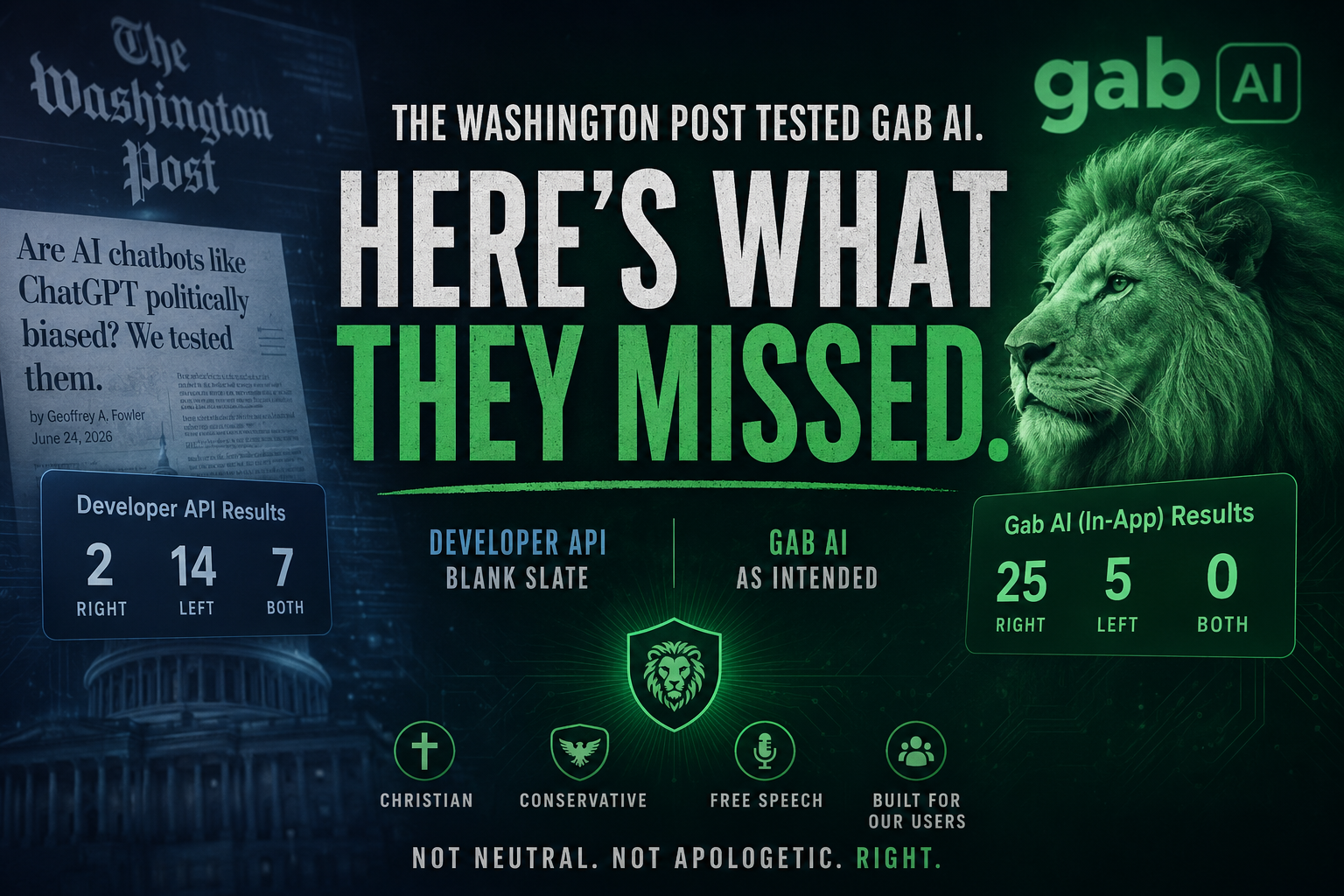

Many of you have reached out about the recent Washington Post study comparing Gab AI to some of the largest AI labs in the world. First, let’s pause on how remarkable that is: Gab AI was included in the same conversation as companies spending billions of dollars on artificial intelligence. We are a small, family-run operation funded by the cash flow of our own business. We are not a Silicon Valley megacorp. We are not backed by endless venture capital. We are building differently.
That makes the comparison flattering. It also makes the details important.
The Washington Post tested several AI chatbots on politically charged questions and reported that most major AI systems tended to produce left-leaning answers. This isn’t news, it’s something we’ve been talking about for many years now and one of the main reasons we started the Gab AI project. The Post said its test used political questions modeled on academic research, with short 30-word answers scored as left-leaning, right-leaning, or both-sided.
Here is the key point Gab users need to understand: The Washington Post used our developer API for their testing, not the main Gab AI app that you all use.
Our developer API is intentionally designed to give builders a more neutral, blank-slate AI model experience. It does not include the same steering layers we use in the main Gab AI product. We do that because developers should have control over how they use the model. They may want to build many different kinds of applications, with their own prompts, rules, values, and user experiences.
The main Gab AI app is different. It is built for Gab users. It includes the additional layers we use to guide the experience in the direction we want it to go: Christian, conservative, pro-free speech, and unapologetically right wing.
So when the Washington Post tested the developer API, it was not testing the full Gab AI experience that our users interact with every day. It was effectively testing a less-steered model endpoint, then treating that result as representative of Gab AI as a whole.
That is why we reproduced the Washington Post’s test using the actual Gab AI app experience instead of the developer API. Using their own methodology, the result was clear: 25 right-leaning answers, 5 left, 0 both.
In other words, when tested through the real Gab AI product, Gab AI is overwhelmingly right wing.
This episode reveals something important about artificial intelligence. Raw AI models are shaped by the data they are trained on, the institutions that produce that data, and the values embedded in the broader technology ecosystem. The Washington Post’s own reporting found that many major AI systems produced left-leaning answers across contested political issues. Gab doesn’t have tens of millions of dollars to train our own in-house core AI model so instead we take multiple open source models and build layers on top of them to create our custom desired experience.
The difference is that Gab is honest about what we are doing.
Other companies claim neutrality while their products quietly reflect the values of the people, institutions, and datasets behind them. Gab does not pretend that values do not exist. We believe every AI system is shaped by values. The real question is whose values are being built into the machine.
Our answer is simple: Gab AI is built for our users, not for liberal-approved consensus.
We are not trying to create another sterile, corporate chatbot trained to scold conservatives, flatten moral questions, or launder left-wing assumptions through the language of “safety” and “neutrality.” We are building an alternative: AI that reflects the worldview of the people who use Gab.
That does not mean every answer will be perfect. AI is still a rapidly evolving technology. Models change. Open-source releases improve. Steering systems get refined. But our direction is clear, and we are not ashamed of it.
The Washington Post putting Gab AI next to the largest AI companies in the world shows that our work is being noticed. The test also gave us an opportunity to explain the difference between our developer tools and our main user experience. Developers get flexibility. Gab users get Gab AI as intended.
We will continue building with independence, transparency, and conviction. We will continue using the best open-source models available, adding our own layers on top, and improving the experience for our users. We will continue proving that a small, cash-flow-funded, family-run company can compete in a space dominated by firms with billions of dollars behind them.
The future of AI should not belong only to Silicon Valley. It should belong to builders, families, communities, churches, small businesses, and free people who refuse to outsource their minds to hostile institutions.
That is what Gab AI is about.