

Our world runs on a lie so foundational and pervasive that most people cannot see it even when it is pointed out directly to them. The “fish in water” metaphor illustrates this problem well with how the most obvious and all-encompassing realities of our lives are often the hardest for us to perceive. Just as fish swim through water without realizing it exists, we often fail to recognize the environments that surround and influence us daily.
The lie that I’m referring to is that public life can be neutral about God and the root of this lie is liberalism. Not just “the left,” but liberalism in all its fullness including conservatism, libertarianism, classical liberalism and the various other “right wing” forms liberalism takes.
I want start my argument by making it clear that Christian Nationalism is a post-liberal project. We aren’t seeking to baptize liberalism or return to some earlier form of it. Part of our self-evident central thesis is that the liberal project has failed.
We will point to many obvious reasons why this is the case, but perhaps most obvious is the rapidly declining birth-rates across the West. The entire Western world fully embraced liberal, egalitarian, open society democracy and the end result was civilizational suicide and a people that can’t be bothered to continue existing. I could very easily rest my case right there, but some of you really need to better understand the full fruits of liberalism in all its forms and so I must continue at length to dismantle it in full.
Liberalism presented itself as a peace treaty. The proposal was subversive in its simplicity: we will remove God from the public square, not by denying Him, but by making Him private. People may worship as they please behind their own doors. The state will not take sides. The law will be a fair framework within which individuals pursue their own visions of happiness. No more wars of religion. Just tolerance, procedure, and the quiet management of a secular age.
Of course we now know that the public square was never emptied of religion, it was merely occupied by a different god with a different creed. The new god called itself Reason, Progress, Humanity or the Market, and its creed was that man is an autonomous individual whose highest purpose is to choose his own values and pursue his own satisfaction, unbound by obligation to any ancestor or authority or moral order he did not personally select. This was a new religion and it demanded the same total allegiance as the old one.
The liberal state punishes blasphemy constantly. The baker who refuses to decorate the cake is not charged with heresy, he is fined for discrimination and dragged through years of endless legal battles. The pastor who preaches the full counsel of God on human sexuality is not burned at the stake, he is deplatformed, his church is investigated and his reputation is destroyed in every major newspaper over the course of a single news cycle. There is an official liberal creed. You will affirm it publicly and there are consequences for your refusal.
What makes the liberal arrangement uniquely dangerous is that it convinced Christians to accept the terms of their own captivity as a matter of principle. The private-public split was sold to the Church as a protection: keep your faith out of politics and politics will keep out of your faith. The state, meanwhile, made no such bargain. It expanded steadily into every sphere once governed by family, church, and local community, shaping souls through mandatory schooling, forming desires through regulated markets, and enforcing its own moral vision through an ever-growing apparatus of courts and agencies. The separation was always a fiction. The only question was which faith would do the separating.
The Christian Nationalist response to all of this must begin with a refusal to accept the liberal premise. We do not ask the state to be neutral. We now know that neutrality is a metaphysical impossibility and the demand for it is a trap. We want the state to be just. We ask the magistrate to punish evil and protect the innocent and honor the Church and serve the common good under the authority of Jesus Christ.
The liberal vision of man is a ghost, a floating will attached to a bundle of appetites, entering the world without parents, without debts, without inheritance, without any obligation that was not freely chosen. This creature has obviously never existed and is a figment of the liberal imagination. Real human beings are born into families. They inherit languages and customs and moral instincts before they are old enough to consent to any of it. They belong to a people, a nation, a living chain of memory and obligation stretching backward to the dead and forward to the unborn. They are sons and daughters first, and the capacity to choose meaningfully depends on having first received an inheritance worth choosing from. Liberalism has robbed us of that inheritance.
The liberal hates this account of man because it implies limits on state power that the regime cannot accept. If men are born into obligations they did not choose, then the state cannot legitimately dissolve those obligations in the name of liberty. If nations are real communities of blood and memory and faith, then the state cannot legitimately replace the historic population with a new one and call the result progress. Liberalism must deny all of this because liberalism needs man to be infinitely malleable, a raw material for the administrative machine to process and improve.
The egalitarian impulse of liberalism also flows from the same source. If man is nothing but a chooser, then all differences between men must be either accidents of circumstance or evidence of injustice. Natural hierarchy, the fact that some men are wiser or stronger or more virtuous than others, becomes an embarrassment. The result is a society where all legitimate authority has been dissolved and replaced by the illegitimate authority of whoever happens to control the administrative apparatus.
We affirm that all men bear the image of God and possess inherent dignity. We also affirm that God made a world of order, not chaos, of hierarchy, not leveling, of distinct offices and distinct gifts and distinct duties. A father is not a mother. A wise man is not a fool. A virtuous man is not a scoundrel. These distinctions are built into creation, and a society that tries to erase them will first become ridiculous and then become tyrannical as we’ve seen happen with liberalism, because reality cannot be erased, only denied, and the denial requires ever-increasing unjust coercion.
Democracy is of course the ultimate political expression of egalitarianism. It is the belief that legitimacy flows upward from the consent of the governed, that the voice of the people is the voice of God, that a majority vote can settle any question and sanctify any outcome. This is not the biblical teaching on civil authority, which holds that the magistrate is God’s servant, accountable to God, authorized by God to punish evil and protect good whether or not the people approve. Fifty million people can be wrong. A majority can vote for murder and call it choice. A majority can vote to open the borders and dissolve the nation and call it compassion. The numbers only reveal how thoroughly a people has been catechized by a lie.
Our vision for the Christian prince is not an absolute monarch answerable to no one. He is bound by God’s law, accountable to the Church’s witness, restrained by custom and lower magistrates and the duty to govern for the common good rather than private appetite, but he does not derive his legitimacy from a vote. He derives it from his office, which God ordained, and his faithfulness in executing that office according to justice. A Christian political order may or may not use elections as a practical mechanism for selecting and restraining rulers, but it may not treat elections as the source of moral authority.
Our same central critique of liberalism applies to the economic realm. The liberal market is a mechanism for rewarding certain behaviors and punishing others, and the behaviors it rewards in the absence of Christian restraint are greed, usury, pornography, the destruction of local communities, the reduction of workers to interchangeable inputs, and the concentration of power in the hands of people who hate Christ. The market is a tool. A Christian economy must be governed by moral ends. The magistrate has the right and duty to restrain monopoly, punish fraud, break usury, protect the family wage, defend local industry, secure borders against labor arbitrage, and order economic life toward the common good of the people under his care. Profit is not a god and efficiency is not the highest virtue. A factory closing in Pennsylvania and reopening in Guangzhou is dispossession, and a Christian ruler will treat it as such.
Libertarianism, which seems to many young men like a principled alternative to the managerial state, is just liberalism in its purest form. It takes the logic of individual autonomy and pushes it to its endpoint. All coercion is evil. All authority is suspect. The state should be minimized to the point of disappearance. Scripture teaches that the magistrate is ordained by God and bears the sword for a reason. Righteous coercion is justice. When the state punishes murderers protects children, imprisons thieves, and shuts down pornographers, it coerces. That is its job. The question is whether power will be public and accountable under God’s law or private and exercised by corporations and mobs and algorithms with no accountability at all. The weak state produces a vacuum into which private tyrannies rush.
The liberal order presents itself as neutral, but neutrality in matters of truth is not neutrality at all. It is a decision to treat all claims as equally valid, which is itself a truth claim of the most aggressive kind. When the state declares that it will take no position on the nature of God, the purpose of man, or the content of the good life, it is not creating a vacuum where individuals pursue their private visions in peace. It is establishing a public orthodoxy of relativism, enforced with all the unjust coercive power it pretends not to have. The state that will not confess Christ will confess something else, and the something else turns out to be the dogma that nothing can be confessed publicly at all.
The logical conclusion of this arrangement is moral relativism. Either you believe Christianity is superior to all other religions or you do not. Either Jesus Christ is the only name under heaven given among men by which we must be saved, or He is merely one option among many, a preference for those who happen to like that sort of thing. The second position is apostasy. If Christ is Lord, then every other claim to ultimate authority is false, and a society that treats false gods as equals to the true God is lying about the nature of reality. A Christian who accepts such an arrangement has already surrendered the public confession of his faith, and a faith that cannot be confessed publicly is a faith that has admitted its own irrelevance.
Should a Christian want to live in a world where heathens and pagans are equals in society? The answer is obviously no, and the reason is not hatred of the pagan but love of the truth and love of the neighbor who is being lied to. To treat idolatry as a legitimate alternative to the worship of the triune God is to participate in the lie that damns the idolater. The Christian is commanded to love his neighbor, and love does not mean affirming him in his rebellion. Love means telling him the truth and ordering society in such a way that the truth is honored and the lie is not given equal standing. A Christian society does not persecute the unbeliever or compel his conscience, but neither does it pretend his unbelief is morally equivalent to Christian faith. The public square is a commons ordered under the Lordship of Christ, and the King does not share His throne with Baal.
We are not calling for a theocracy where the Church rules by the sword or where unbelievers are driven from the public square. We are calling for a Christian nation where public truth is ordered to the glory of God and the good of the people, where the magistrate knows he is a servant of Christ, where the law reflects created reality rather than revolutionary fantasy, and where the false gods of the age are not given equal honor with the God who made heaven and earth. This is the consistent application of the confession that Christ is King, and the Christian who feels uncomfortable with this conclusion should ask himself whether he actually believes that the Gospel is true or merely useful for the management of his personal anxieties.
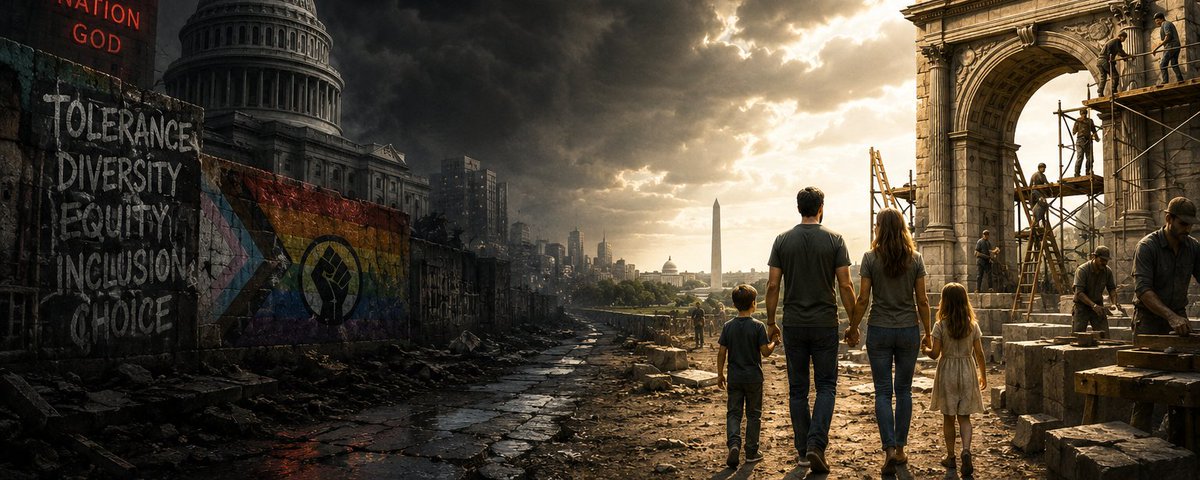
We are entering a post-liberal age. The old order is not dead yet, but its heart has stopped. It cannot transmit itself to the next generation because it has taught the next generation that nothing is worth transmitting. These people can’t even be bothered to reproduce. The only question now is what comes after. Every faction will propose an answer. The technocrats will propose rule by algorithm. The oligarchs will propose rule by capital. The revolutionaries will propose rule by destruction. Christians must propose rule by Christ, and the proposal must take the form of households that actually function, fathers who actually lead, churches that actually preach, schools that actually teach, businesses that actually serve, and communities that actually care for their own.
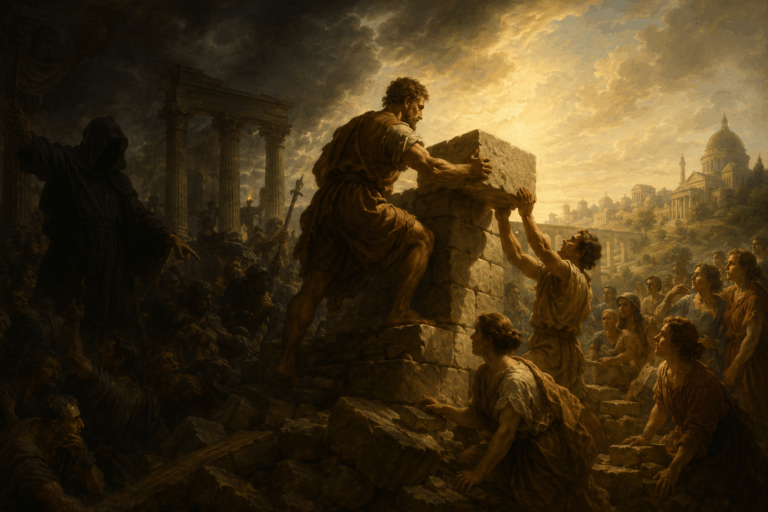
The post-liberal Christian nation will be a hierarchical order. It will be patriarchal. It will be particular; a nation of, by, and for a specific people. It will recognize degrees of membership: those who are of the nation by blood and faith, those who are sojourners and guests, and those who have no place within the gates. It will enforce its borders. It will protect its culture. It will worship God. It will raise its sons to be men and its daughters to be women. It will reject the lies of egalitarianism and the poison of universalism. It will be, in short, a nation rather than a shopping mall with a flag. This is the only sustainable form of human community. Every other arrangement is a temporary experiment that eventually collapses into chaos or tyranny. The liberal order is in its final stage of decomposition. Our task is to be ready to pick up the pieces, to build something that honors God, protects our people, and endures.
The post-liberal age will be confessional. Everyone will confess something. The only question is whether Christians will stop apologizing long enough to confess the King.