

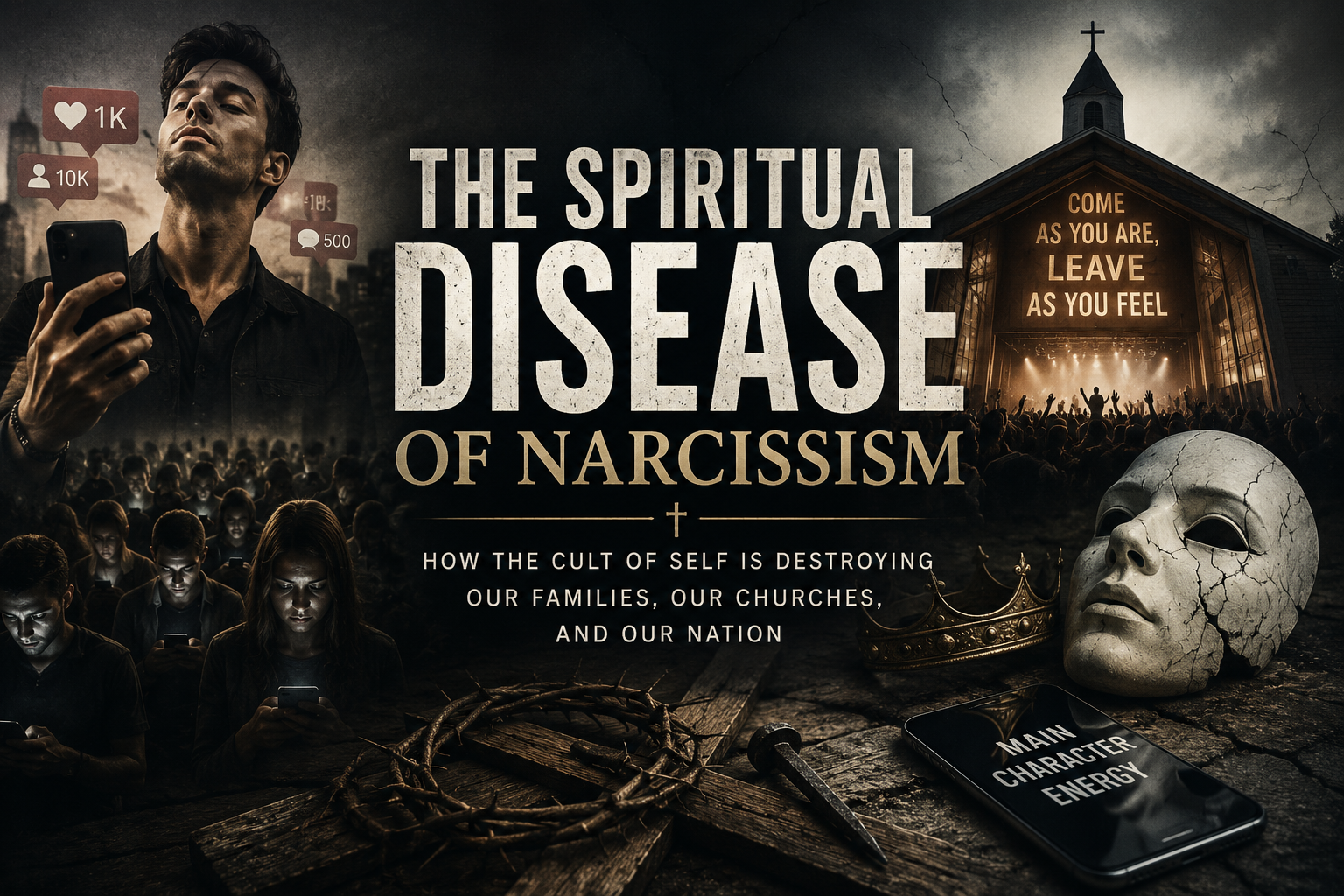

The defining mark of our age is narcissism.
We have built a society of people who believe every relationship exists to affirm them, every institution exists to serve them, every hardship is an injustice against them, and every other human being is a supporting character in the story of their own feelings. This is a spiritual disease, a cult of the self, and it is destroying our families, our churches, our friendships, our institutions, and our nation.
Everyone is performing now. People do not simply live; they stage-manage themselves and turn friendships into networks, conversations into content, church into an experience, charity into branding, suffering into attention, and even repentance into a public relations exercise. The family has been replaced by the audience. We are no longer a people bound together by blood, faith, duty, and sacrifice, but rather a collection of personal brands, each one screaming into the void, desperate to be seen, and terrified that being seen will still not be enough.
The world even has a phrase for this sickness: “main character energy.” That phrase is more revealing than the people using it understand. It names the lie at the center of modern life, the lie says your feelings are ultimate, your story is ultimate, and everything and everyone must orbit around you. This is obviously satanic and the old temptation in a new costume: “Ye shall be as gods” (Gen. 3:5).
Perhaps more shocking is that this filth has entered the Church. Many professing Christians no longer want the Gospel that crucifies the self, instead they want a therapeutic religious product that soothes the self and holds Jesus as a life coach, not Jesus as Lord. They want worship that affirms their preferences, sermons that validate their emotions, community that costs them nothing, and pastors who function like customer service representatives.
They essentially treat the Bride of Christ like a cable provider: if the sermon is too direct, they complain. If the music is not their taste, they leave. If the people are difficult, they move on. If the church asks them to serve, sacrifice, repent, submit, forgive, or endure, they decide it is no longer a “good fit.” This is part of why so many modern churches are being run like consumerist corporations designed to make people “feel good” about themselves so they keep coming back. That’s not Christianity.
Christ did not say, “If anyone would come after me, let him affirm himself, prioritize his feelings, and find a community that meets his needs.” He said, “If anyone would come after me, let him deny himself and take up his cross daily and follow me” (Luke 9:23). Deny himself. Take up his cross. Daily. That is the Christian life. It is not self-discovery. It is self-death. It is the crucifixion of the ego. The cross is not an accessory, it is an instrument of execution.
The modern Christian hates this because he has been discipled by the world more deeply than he has been discipled by the Word. He knows the language of faith, but he retains the posture of the consumer. He says “community,” but he means emotional convenience. He says “authenticity,” but he means permission to remain immature. He says “grace,” but he means exemption from correction. He says “calling,” but he means personal ambition with religious vocabulary. He says “hurt,” but often means someone finally told him the truth. This is why so many churches are full of people and empty of any actual brotherhood.
The Apostle Paul tells us to do nothing from selfish ambition or conceit, but in humility to count others more significant than ourselves (Phil. 2:3). That command alone would destroy the spirit of the age if Christians obeyed it. Count others more significant than yourself not because they flatter you or because they are useful to you. Do it because Christ humbled Himself, took the form of a servant, and became obedient unto death, even death on a cross (Phil. 2:5-8). Christian humility is not weakness, it is conformity to Christ.
The rot of narcissism has also destroyed the very concept of duty in our society. Duty means doing what is required because it is required, whether or not it benefits you, excites you, rewards you, or makes you look good. Modern people hate duty because duty is indifferent to their feelings. A father must provide whether he feels inspired or not and a mother must nurture whether she is praised or not. A citizen must defend his people whether the regime calls him names or not. These are our duties and a Christian must obey God whether obedience is emotionally satisfying or not. Duty is the death of childishness, but unfortunately we live during a time of endless adolescence when we desperately need adults.
This has produced generations of people who can simulate virtue while avoiding sacrifice, people who know how to sound compassionate, how to post the approved words, how to signal concern, how to say “thoughts and prayers,” how to raise awareness, how to share the graphic, how to perform empathy in public, and yet who vanish the moment the cameras are off, the post stops trending, the applause disappears, and the cost becomes real.
True sacrifice is offensive to the modern soul because sacrifice requires the death of the ego. We have been trained from childhood to believe our personal narrative is the most important story being told. Parents told us we were special, schools told us we could be anything, advertising told us we deserved everything, therapists told us our feelings were sacred, entertainment told us we were heroes waiting for our moment, and social media gave us a stage and called it connection. After decades of this many people can no longer recognize another person’s need as a claim upon them instead they see it as an interruption.
A people ruled by narcissism cannot build a civilization. Institutions are not abstractions; they are made of souls. Nations are formed by households, churches by members, schools by teachers and families, businesses by workers and customers, and every one of these bodies eventually takes the shape of the people inside it. Self-absorbed people build self-serving institutions. Vain men produce vain leadership. Restless households produce unstable communities. Cowardly pastors produce cowardly churches. Selfish citizens produce a hollow nation. There is no structural solution for a people who refuse repentance. We can’t vote our way out of this.
The clearest evidence of this rot is the collapse of the birth rate. A society that worships the self will stop having children. This is not complicated. Children are the end of autonomous self-worship: they cost money, sleep, time, comfort, attention, plans, ambition, and freedom. They interrupt everything. They expose selfishness. They make demands that cannot be postponed. They do not care about your brand, your schedule, your aesthetic, your personal journey, or your need to feel seen. They need food, discipline, prayer, protection, teaching, affection, and correction. In other words, they need adults in a world filled with perpetual children who take endless trips to Disney World and binge watch Marvel movies.
The modern ego sees children as a burden because the modern ego is sterile. It can generate content, opinions, careers, consumption, and experiences, but it cannot produce inheritance, because inheritance requires sacrifice, continuity, and love for a future the self may never personally enjoy. A people too selfish to have children has already voted itself out of the future. The demographic winter descending on the West is not merely economic; it is spiritual. We stopped having children because we stopped believing the future was worth our sacrifice, that our people were worth continuing, and that obedience was better than comfort.
The state cannot cure this with subsidies, corporations cannot cure it with parental leave policies, and economists cannot cure it with charts, because the problem is not merely that children are expensive, though they are, or that houses cost too much, though they do, or that the modern economy is hostile to family formation, though it certainly is; the deeper problem is that we have become the kind of people who resent the very things that require us to die to ourselves, and no tax credit can make a selfish people fruitful. Only repentance can reach that depth. Men must repent of refusing fatherhood, women must repent of despising motherhood, and churches must repent of treating the family as an optional lifestyle preference rather than the ordinary engine of Christian civilization. Scripture says that a good man leaves an inheritance to his children’s children (Prov. 13:22). A narcissistic man leaves behind curated memories, consumer debris, and a life arranged around appetites that died with him.
The Christian life is the most radical assault on narcissism the world has ever known, because it does not merely tell the self to behave better, express kinder sentiments, or adopt healthier habits; it commands the self to die. It teaches that the first shall be last, that the greatest must become the servant, that the Son of Man came not to be served but to serve and to give His life as a ransom for many, and that unless a grain of wheat falls into the earth and dies, it remains alone, but if it dies, it bears much fruit. That is the law of Christian fruitfulness. The man who refuses to die remains alone, no matter how large his audience becomes. The man who dies in faith becomes fruitful, often in ways he will never live to measure.
This is why so many attempts to build Christian institutions fail after the excitement fades. The idea is exciting, the announcement is exciting, the group chat is exciting, the first meeting is exciting, and for a brief moment everyone gets to feel like a founder, a builder, a man standing at the edge of history; then the actual work arrives, and someone has to clean the building, keep the books, watch the children, make the calls, answer criticism, give money without being praised, stay late, apologize, forgive, organize the next meeting, and keep showing up after the atmosphere has become ordinary. That is where the narcissists disappear, because they were never there to build. They were there to feel like builders, not actually complete the work.
They wanted the identity without the burden, the social capital of being attached to something bold without the hidden labor that makes bold things real, the proximity to courage without the cost of courage. Every pastor, founder, organizer, father, and builder has seen this pattern. Men appear when there is energy, attention, status, and momentum, then vanish when the work becomes costly, repetitive, obscure, and thankless. This is why you cannot build with men who need applause, with men who calculate every favor, with men who treat every responsibility as a stage, or with men whose first loyalty is not to Christ, household, church, and people, but to the image of themselves they are trying to protect.
Loyalty is not produced by shared opinions alone. Brotherhood is not created by agreeing in the abstract. Real loyalty is formed when men carry weight together, suffer disappointment together, absorb costs together, forgive one another, correct one another, and remain at their posts when the work becomes boring enough to reveal who actually loves the mission. The men you can build with are the men who do not need their names on the announcement, who can take correction without collapsing, who can help another man succeed without secretly resenting him, who can serve when nobody claps, and who understand that the highest form of usefulness is often hidden from the people most eager to talk about usefulness. Find those men. Become one of those men.
The work before us is therefore not primarily political, and it is not even primarily institutional, though it will certainly become both; beneath politics and beneath institutions is the spiritual and ascetic war against the self, the daily decision to keep your word when breaking it would be easier, to help a brother when he cannot repay you, to serve without turning service into a performance, to put wife, children, church, neighbor, and people ahead of appetite, and to become the kind of man who can be trusted with responsibility because he no longer needs every responsibility to validate him. We must recover a culture of non-transactional duty, the kind of duty that does not ask first who will notice, who will pay, who will applaud, or what social advantage can be extracted from obedience.
You are not the protagonist of history. Christ is. You are a steward, a member of a body, a son of fathers you did not choose, and, Lord willing, the father of children who will judge your faithfulness not by what you said you believed but by what you handed them. You are a link in a chain. You are not the chain. Your name will be forgotten by nearly everyone. Your posts will vanish. Your photos will be buried. Your clever arguments will disappear into servers that will one day be turned off. The audience you are performing for is mostly imaginary, and the applause is thinner than you think.
The quiet work will remain. Children raised in the faith will remain. Marriages strengthened by sacrifice will remain. Churches built by patient service will remain. Businesses founded with integrity will remain. Neighbors helped in secret will remember. Sons will imitate what fathers actually did, not what fathers posted. Daughters will remember whether their mothers loved the home or resented it. Communities will remember who showed up when things were hard. God sees all of it, including the work no one thanks you for, and for the Christian that must be enough.
A man who spends his life curating his image will leave behind an image. A man who spends his life serving his people will leave behind a people. One is vapor. The other is inheritance. Choose inheritance. Choose the unseen task. Choose the boring duty. Choose the child over the lifestyle, the wife over the fantasy, the church over the consumer experience, the neighbor over the feed, the people over the brand, and Christ over yourself. Until we learn to act for the good of our people when it costs us time, money, status, reputation, convenience, and comfort, we will remain slaves to our own vanity, able to describe Christendom, market the aesthetic, quote the books, post the slogans, and attend the conferences, but unable to stomach the actual work of rebuilding.
The rebuilding begins when we stop staring at ourselves and start looking at the brother beside us. If he is struggling, help him. If his family is in need, feed them. If he is in sin, correct him. If he is discouraged, strengthen him. If he is alone, bring him in. If his business is worth supporting, support it. If his son is fatherless in practice, mentor him. If his wife is overwhelmed, send help. If his church is weak, serve it. Do the thing in front of you because it is yours to do, and stop waiting for obedience to feel dramatic before you obey.
No one will write a glowing article about this. It will not trend. The regime will not honor it. The influencers will not understand it. But this is the foundation that holds. It is laid in homes, churches, streets, workshops, farms, schools, hospital rooms, dinner tables, nurseries, and gravesides. It is laid when Christians remember that love is not a mood but a duty made visible, when men and women stop demanding to be served and start serving, when the self is dethroned and Christ is obeyed.
You are not the main character. Your comfort is not the mission. Your image is not the inheritance. Your feelings are not the law. Your brand is not the Kingdom. Deny yourself. Take up your cross. Serve your household. Serve your church. Serve your people. Build what your children will need.
Die to yourself, and bear fruit.
Andrew Torba
Christ is King