

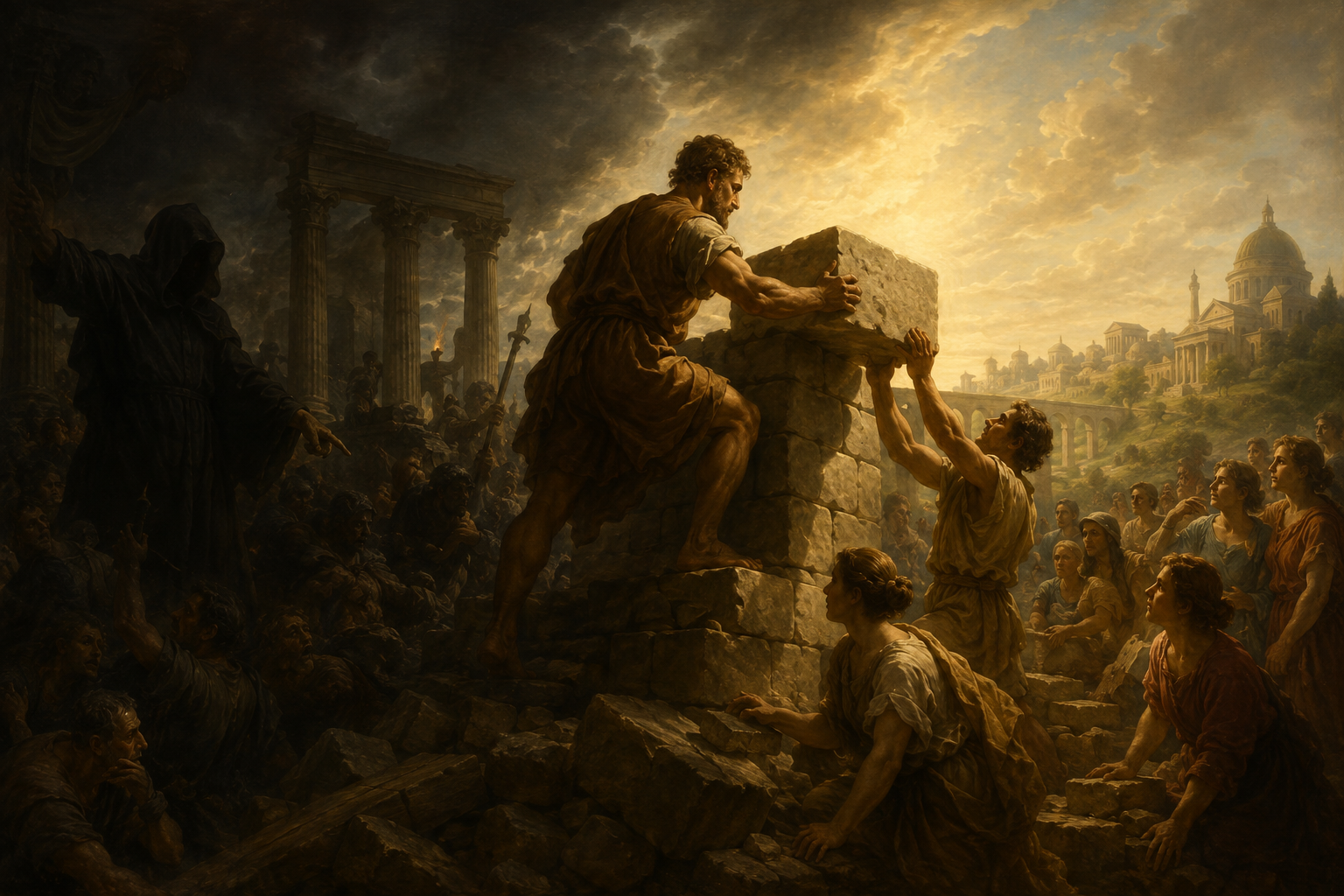

Ten years ago today Gab began with a simple conviction: ordinary people should be able to speak freely online without asking permission from governments, political activists, corporate gatekeepers, or a handful of unaccountable Silicon Valley executives. At the time that conviction seemed almost obvious. The Internet was still routinely described as this great decentralized force for human freedom, yet by 2016 it was becoming increasingly clear that the digital public square was consolidating in the hands of a small number of companies whose executives had tremendous power over what billions of people could say, see, share, and ultimately believe. Gab was our answer to that problem.
I don’t think any of us could have fully appreciated what the next ten years would bring. Gab has been banned from app stores, removed by hosting providers, cut off by payment processors, denied access to critical infrastructure, smeared relentlessly by the corporate press, targeted by activist organizations, dragged into congressional investigations, and pressured by governments both at home and abroad. There have been many moments when the conventional wisdom was that Gab was finished, and there were plenty of opportunities when surrendering would have been easier, safer, and probably much more profitable. We could have changed our rules, apologized to the right people, banned whoever we were told to ban, and slowly transformed ourselves into another sanitized corporate platform.
We chose to build instead and that decision has defined the first decade of Gab.
Gab’s history cannot be separated from deplatforming because deplatforming forced us to understand technological sovereignty years before most people were even thinking about it. In the early days of the Internet economy, the standard advice for building a technology company was to outsource practically everything that wasn’t your core product. You used somebody else’s cloud infrastructure, somebody else’s payment processor, somebody else’s app store, somebody else’s distribution network, and dozens of somebody else’s APIs and services. That model was efficient and convenient, but it contained an enormous hidden assumption: all of these supposedly neutral infrastructure providers would continue doing business with you.
We learned the hard way that this assumption was wrong. When companies decided they could remove Gab from their services because they disliked our mission, our users, or the speech taking place on our platform, we discovered that you don’t really control something when another company can shut it off with the flip of a switch. Free speech could not survive indefinitely on rented infrastructure controlled by people who were hostile to the very reason Gab existed, so we had to become more independent. We built systems ourselves, developed our own technology, established new relationships, eliminated dependencies where we could, and became more resilient with every attack.
Looking back, many of the things intended to destroy Gab ultimately made the company stronger. Every provider that abandoned us exposed another weakness we needed to address. Every coordinated pressure campaign taught us something about how technological power actually works. Every attempt to silence our community reinforced the importance of owning more of our infrastructure and reducing the number of institutions capable of exercising veto power over our existence. Out of those experiences emerged a principle that continues to shape everything we build today: never allow a single gatekeeper to become a single point of failure.
There is a fantastic recent essay called The Closure of the Internet that I encourage everyone to read because it documents, in extraordinary detail, the transformation we lived through during the years when Gab was fighting its hardest battles. The author traces how the Internet of the early 2010s where major platforms generally permitted almost anything lawful rapidly changed beginning around 2015 into an Internet governed by sprawling moderation systems, increasingly expansive definitions of “hate” and “misinformation,” pressure from governments and NGOs, demonetization, algorithmic suppression, and coordinated deplatforming.
Free speech is very easy to support when everyone agrees with what is being said. The principle becomes meaningful when speech is controversial, unpopular, politically inconvenient, offensive, or directed at people with enough power to make you suffer for permitting it. Gab has spent ten years living in that second category. We have defended the principle that lawful speech should remain free even when governments, journalists, activist organizations, corporations, and powerful interest groups demand otherwise, and doing so has come with tremendous costs.
We weren’t trying to build Twitter with a green logo. We were trying to demonstrate that Americans could still build institutions committed to the principle that free speech should not require ideological permission, and that mission inevitably meant accepting costs that companies without such a conviction would never tolerate.
The Cost Was Personal Too
Those costs were never limited to servers, payment processors, lawyers, or lost business relationships. My family has lived with the consequences of my decision to build Gab for ten years. We have been doxxed, threatened, harassed, and forced to think about things that most families should never have to think about simply because I built a website and refused to abandon it. I made the decision to start Gab; my family didn’t, and watching the consequences of that decision spill over onto my wife and children and extended family has always been the hardest part of this journey. There were moments when walking away would have made our lives much easier, but my family stood by me through all of it, and their sacrifice is as much a part of Gab’s story as anything I have personally endured. I will never be able to properly repay them for that.
As Gab grew, the censorship pressure increasingly came not only from technology companies and activist organizations, but from governments themselves. Authorities and regulators in countries including Germany, the United Kingdom, and Australia have pursued increasingly aggressive approaches to online speech, and the implications of these systems do not necessarily remain confined within their own borders. When governments pressure American technology companies to police speech according to foreign standards, they are effectively attempting to export their censorship regimes into the American digital public square.
Gab has consistently pushed back against that idea because there is a principle here much larger than our company. We reject the notion that foreign bureaucrats should be able to dictate what Americans may lawfully say on an American platform. We did not spend years fighting Silicon Valley censorship only to hand the same power to government officials overseas, nor do we believe technology companies should voluntarily transform themselves into enforcement arms for every government that invents a sufficiently broad definition of harmful speech.
This distinction is becoming increasingly important because the architecture of the Internet does not respect national boundaries in the way traditional media once did. If every country’s censorship laws are allowed to dictate what an American platform can display globally, the practical result will eventually be that the most restrictive government determines what everyone is allowed to say. We believe the proper response is exactly the opposite: defend lawful expression, resist attempts to impose extraterritorial censorship, and force governments to justify their demands through legitimate legal processes rather than expecting technology companies to obediently police political speech on their behalf.
There is one part of this story that I cannot leave out because it is impossible for me to honestly explain how I made it through the past ten years without talking about my faith in Jesus Christ. There were moments when the company was under enormous pressure, when the media attacks seemed endless, when infrastructure was disappearing underneath us, when my family was being dragged into something they never asked for, and when I had no obvious reason to believe that things were going to work out. Through those moments my faith gave me something much more important than confidence in a particular business outcome: it reminded me that I was not ultimately in control and that my responsibility was to remain faithful, do the work placed in front of me, protect my family, stand for what I believed was right, and trust God with the outcome.
My faith has also changed enormously over the course of these ten years. Trials have a way of stripping away the shallow version of Christianity that is easy to maintain when everything is comfortable. When the world is applauding you, faith can remain theoretical. When doors are closing, people are attacking you, your reputation is being destroyed in public, your family is paying a price, and you genuinely do not know what tomorrow is going to bring, you discover very quickly what you actually believe. Again and again I was reminded that worldly approval is temporary, worldly institutions are temporary, businesses are temporary, and ultimately my identity cannot rest in Gab, in what journalists say about me, in how much money we make, or even in whether the company succeeds. My identity has to be rooted in Christ.
Looking back now, I can see God’s providence throughout so much of what happened, including in things that felt catastrophic at the time. Doors closing forced us to become independent. Being rejected by institutions forced us to stop seeking their approval. The pressure forced me to examine what I actually believed and why I was willing to fight for it. The hardships made me a better builder, a better leader, and, more importantly, pushed me to become more serious about being a Christian husband and father. I would never pretend that I handled every moment perfectly, because I didn’t, but I can say with certainty that I would not have made it through this decade without Christ.
That is also why the mission today is about more than simply building successful technology companies. Technology shapes culture, culture shapes people, and increasingly artificial intelligence will participate directly in shaping how people understand truth, morality, history, faith, family, and themselves. If we believe Christ is King, then Christians cannot voluntarily abandon one of the most consequential technologies of our lifetime and simply hope that people who reject our worldview will build it in ways that are healthy for our children and grandchildren. We have a responsibility to build, to create, to compete, and to bring our values into these new systems rather than retreating from them.
Standing Firm Under Political Pressure
Gab has also faced extraordinary political scrutiny here at home. Following January 6, Gab became one of the technology platforms subjected to congressional scrutiny and demands for information, including from the January 6 Committee. The atmosphere surrounding that period was unlike anything we had previously experienced because technology platforms were increasingly being treated not simply as places where people communicated, but as institutions that could somehow be held politically responsible for the statements and actions of millions of independent users.
We rejected that premise because taken to its logical conclusion it makes genuinely open communication impossible. Gab did not organize January 6, nor did Gab control the actions of people in Washington. We operated a communications platform used by millions of individuals with different beliefs, motivations, backgrounds, and political opinions. If a platform becomes responsible for every statement made by every user, the only rational response for the platform is massive preemptive surveillance and censorship. The inevitable result is not a safer public square, but a digital environment where platforms aggressively suppress anything remotely controversial because permitting open discussion creates unacceptable political and legal risk.
That is precisely the Internet Gab was created to oppose. A genuinely free platform cannot exist if its operating principle is constantly asking what politicians, journalists, activist organizations, or government investigators might think about every conversation occurring on it. At some point you have to decide whether users are adults responsible for their own lawful speech or whether technology companies are expected to become private-sector speech police. For ten years, Gab has consistently chosen the former.
The COVID era demonstrated why these principles mattered in a way that few previous events had. Suddenly questions involving medicine, public policy, employment, education, religious liberty, and personal autonomy became deeply intertwined with online censorship. People were removed from platforms for questioning official claims, doctors and researchers found themselves punished or marginalized for presenting dissenting views, and families faced enormous pressure from employers, schools, universities, hospitals, and governments. Information that contradicted institutional consensus could be labeled dangerous before ordinary people were even permitted to evaluate it for themselves.
Gab remained open throughout that period, and our community used that freedom to share research, personal experiences, legal resources, religious exemption materials, and vaccine exemption documents that ultimately reached millions of people. For the families using those resources, these weren’t abstract arguments about content moderation. Their jobs, education, livelihoods, and ability to provide for their families were sometimes at stake. They needed somewhere to communicate with other people experiencing the same pressures and somewhere to access information that had become difficult to distribute through mainstream channels.
We did not believe then, and do not believe now, that unelected technology executives should determine which questions the public is permitted to ask about matters of enormous personal consequence. Scientific and public-policy disputes should be resolved through evidence, argument, scrutiny, and open debate rather than account suspensions and algorithmic suppression. Whatever someone thinks today about the specific disputes of that period, the broader lesson should be obvious: once we grant technology companies the authority to determine which side of a rapidly evolving public controversy is permitted to speak, we should not be surprised when that authority is eventually used against us.
When Elon Musk purchased Twitter, I knew that in many ways Gab Social’s original mission had been accomplished. Twitter, now X, is not perfect. Nothing ever is, and I don’t expect any platform run by human beings to be. But anyone who remembers what the Internet was like between 2016 and 2022 can see that the environment today is miles ahead of just how bad things had become. Ideas and conversations that would have resulted in immediate suspensions or algorithmic burial during that period are now discussed openly by millions of people, and the very concept of online censorship has become a mainstream political issue rather than something dismissed as a conspiracy theory.
Gab Social still has a dedicated and loyal community that I love, and Lord willing it will remain here for another decade and beyond. We built it to survive, and should widespread censorship return in the way we experienced during those years, Gab will still be standing as an independent home for free speech. I have no intention of abandoning that mission or the community that carried us through the darkest years of online censorship.
At the same time, leadership requires recognizing when the battlefield has moved. The censorship battle is not over, but the center of gravity is shifting away from social media and toward something that I believe will ultimately be far more influential on human minds than any social network ever was: artificial intelligence.
The Next Battle Is Artificial Intelligence
The first decade of Gab was largely about protecting what people were allowed to say. The next decade is increasingly going to be about what people are allowed to ask, what answers they are allowed to receive, what information an AI system chooses to surface or suppress, and ultimately how the systems sitting between human beings and the world’s accumulated knowledge are programmed to interpret reality. Social media controls distribution, but artificial intelligence increasingly participates in the creation, interpretation, and presentation of information itself, and that distinction makes the stakes enormously higher.
These systems are going to be far more influential on human minds than I think most people currently understand. Children will grow up learning from them. Students will use them instead of traditional search engines. Workers will collaborate with them every day. Programmers will build software with them. Writers will research with them. Businesses will make decisions with them. People will ask them questions about history, politics, religion, morality, relationships, medicine, law, and practically every other subject imaginable. Over time, AI will become less like a website you visit and more like an intellectual layer sitting between you and the digital world.
That is why we cannot make the same mistake twice. We cannot spend the next decade allowing a handful of Big Tech companies to build enormous AI walled gardens, get billions of people dependent on them, establish the ideological boundaries of these systems, and then suddenly decide in 2036 that perhaps Christians and conservatives should have built something of their own. By then it will be too late. We have to build now, while the technology and the market are still taking shape.
Gab AI is not an unrelated side project or an attempt to chase whatever happens to be fashionable in technology. It is a direct continuation of the mission that started Gab in 2016. When we looked at the emerging artificial intelligence industry, we immediately recognized many of the same structural problems we had encountered during the rise of social media. A relatively small number of enormously powerful technology companies were racing to build systems that could eventually mediate how billions of people search the Internet, write, program, research, analyze documents, create media, learn history, understand politics, operate businesses, and make decisions.
We had already lived through what happens when a handful of corporations gain enormous control over the digital public square, and we weren’t interested in waiting another decade to discover what happens when many of those same institutions become gatekeepers to artificial intelligence. The stakes are arguably even greater this time because social media primarily controls the distribution of information, while AI increasingly participates in deciding how information is summarized, interpreted, framed, and presented to the person asking the question.
If we believe that these systems will become foundational to modern life, then Christians and conservatives cannot simply be permanent tenants inside systems owned and controlled by people who do not share our values. We must have our own. We must build models, infrastructure, products, and institutions that reflect our values and that we ultimately control. That does not mean refusing to use technology built by anyone else. It means ensuring that we are never again in a position where a handful of hostile gatekeepers can change the rules and effectively lock us out of the future.
One of the fundamental reasons Gab AI exists is that we do not believe mainstream artificial intelligence is politically neutral. We have spent years using and testing the major AI models, and in our experience consistent ideological patterns emerge when you start asking difficult questions involving politics, religion, race, sex, immigration, nationalism, abortion, COVID, elections, history, and other controversial subjects. These systems can be incredibly capable and useful, and we make many of them available through Gab AI precisely because of those capabilities, but technical intelligence should never be confused with ideological neutrality.
An AI model does not descend from the heavens as an impartial oracle of truth. Human beings choose and curate training data, conduct post-training, write system instructions, establish moderation policies, define categories such as “harm,” “misinformation,” “hate,” and “extremism,” and decide which types of model behavior should be rewarded or suppressed. Even when an underlying model has absorbed an enormous diversity of human knowledge, the product users ultimately interact with has been shaped through layers of human judgment, and those decisions inevitably reflect assumptions and values.
In our experience, mainstream AI systems overwhelmingly reflect the cultural and political assumptions dominant within the institutions responsible for building them: Silicon Valley, elite universities, corporate America, the mainstream press, and the broader progressive professional class. We heard similar assurances about neutrality during the rise of social media, only to watch moderation rules expand, definitions change, algorithms influence what people could see, and enforcement repeatedly collide with conservative, Christian, populist, and dissident viewpoints. It would be foolish to assume that artificial intelligence, built within many of the same institutional environments, somehow exists outside those cultural forces.
The difference is that AI potentially gives those assumptions much greater influence. A social media company can prevent you from publishing something or make it difficult for other people to discover what you said. An AI system can shape the answer to your question before you even realize another perspective exists. As more people replace traditional search engines and direct research with conversations with AI, these models increasingly become intermediaries between human beings and knowledge itself. That makes ideological diversity in artificial intelligence not merely a partisan concern, but an important question about the future architecture of information.
Who Gets to Define the Answers?
This is one of the defining questions of the next decade. If nearly every major doorway into artificial intelligence operates within substantially similar ideological boundaries, we will have created an extraordinarily powerful form of information gatekeeping without ever formally declaring that anyone is being censored. Instead of deleting your post after you say something, the system can simply ensure that millions of people asking about the subject never encounter your argument in the first place.
We believe Christians should be able to interact with artificial intelligence that does not reflexively treat their worldview as something requiring correction. We believe conservatives should be able to explore controversial political ideas without feeling as though every conversation is being mediated by a corporate HR department. We believe people should be able to compare how competing models answer difficult questions, examine where they agree and disagree, and decide for themselves which arguments are persuasive rather than receiving one institutional perspective presented as if it were the only reasonable conclusion.
This philosophy also requires us to be transparent about our own values. We aren’t claiming that our approach somehow eliminates human judgment from artificial intelligence. That would simply repeat the mistake we are criticizing. Instead, we believe different worldviews should be represented openly and honestly so users can make informed choices about the systems they use.
Arya, our in-house AI model, is our attempt to build that alternative. Rather than pretending that an AI can somehow be completely detached from the worldview of the people shaping it, Arya is intentionally built around Christian values and conservative principles. We are open about that because I would rather tell users plainly what our values are than participate in the fiction that values disappear merely because they have been encoded into model behavior, system instructions, training decisions, or moderation rules.
At the same time, building Arya does not mean we believe everyone should be forced to use Arya or that Gab should become another gatekeeper deciding which model is acceptable. Quite the opposite. Gab AI provides access to models from across the broader industry precisely because our answer to ideological centralization is choice. Use Arya for one question and a mainstream model for another. Ask several models the same controversial question and compare their answers. Look at what each emphasizes, what each omits, where they agree, and where their underlying assumptions become visible. The user should remain the person making the final judgment.
That is an important distinction between our philosophy and the walled-garden model that increasingly dominates technology. We are not asking people to escape one technological master so they can become dependent on another one wearing a Gab logo. We want Gab AI to provide a durable layer of choice between the user and an AI industry that is changing at extraordinary speed.
Ten Years Taught Us How to Build the Next Ten
There is a direct line connecting everything Gab has experienced since 2016 with what we are building today. Deplatforming taught us about dependency. Payment processor bans taught us about financial gatekeeping. Infrastructure bans taught us about technological sovereignty. Government censorship demands taught us that political pressure does not stop at national borders. COVID taught us how quickly institutional consensus can become a justification for suppressing legitimate questions and dissent. The explosion of artificial intelligence is now teaching us that the next great gatekeeping system may not simply decide who is allowed to speak, but increasingly influence how billions of people understand the world.
In that sense, I don’t look at the first ten years of Gab as one chapter that is ending while some unrelated AI company begins another. It is one continuous story. We were forced to learn lessons about technological independence earlier than most companies because we experienced the consequences of dependency earlier than most companies. Those lessons were painful, expensive, and at times deeply personal, but they prepared us for what I believe is coming next.
So as I look toward Gab’s second decade, I am grateful for what Gab Social accomplished and for the community that continues to make it what it is. When Elon purchased Twitter and dramatically reopened the boundaries of acceptable political speech there, I knew that an important part of the mission we started in 2016 had succeeded far beyond Gab itself. The Internet today is not perfect, censorship has certainly not disappeared, and there is no guarantee that the political environment won’t shift again, but compared with the suffocating atmosphere that existed from roughly 2016 through 2022, we have made enormous progress.
Gab Social will remain here, Lord willing, serving the loyal community that has carried it through the past decade and standing ready should widespread censorship return in force. We built it to survive, and I still believe an independent free speech platform has tremendous value precisely because political conditions can change much faster than people expect.
That is what Gab has always done. When they told us we couldn’t have a platform, we built one. When they told us we couldn’t have infrastructure, we found ways to become more independent. When they tried to make the cost of defending free speech unbearable, our community carried us through it. Now a new technological frontier is opening in front of us, and once again we have a choice between complaining about who controls it and doing the difficult work of building something ourselves.
After everything that has happened over these ten years, I know better than to pretend I can predict exactly what the next ten will bring. I don’t know what new attacks will come, what technologies will emerge, what political conditions will change, or where this road ultimately leads. What I do know is what the past decade has taught me: build before you desperately need what you’re building, never surrender control of your future to a single gatekeeper, stand firm when the pressure comes, and above all trust God with the outcome.
Ten years ago Gab started with a simple idea about free speech.
That idea survived everything thrown at it.
Now we’re taking everything we learned from that fight and carrying it into the age of artificial intelligence.
Gab is still here. We’re still building. Christ is King. Here’s to the next ten years.